May 30th, 2007
Ashkelon, Israel
Sderot: My Adopted Town
by Lois Joy
At 5:30 AM, the wind is blowing 18 knots from the south, howling through the
masts of the yachts secured to piers at Ashkelon Marina, the southernmost
marina in Israel. Since sundowners in the cockpit of Pacific Bliss last night,
this wind has rotated 360 degrees. Strange. Yesterday was the lull before
the storm. The afternoon was humid and still, 100º F. in the salon! Gunter
and I escaped to a coffee shop in an air-conditioned mall to read up on the
latest events here in Israel. Then as darkness came, there were flashes of
lightning and clashes of thunder close by. Surprisingly, all that celestial
commotion produced only a few drops of rain. Even though it is cooler now,
I’ve been unable to sleep in. “Write, write,” my inner voice
urged as I lay there wide awake this morning. “Use this day to rid yourself
of all your pent-up stress.” For today is another “free”
day; the wind/waves forecast is still not good for a safe and comfortable
passage to Turkey. 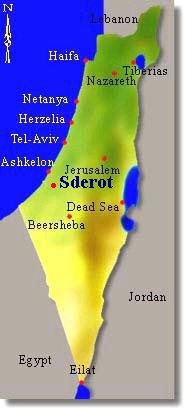
OK, OK. I go up to the galley to make a pot of the Turkish coffee I purchased
at the mall. Then I open the salon doors to the cockpit and scan the horizon.
There is no sunrise to celebrate, just a feeble, dusty-blue sky hiding behind
gray low-lying clouds. Two helicopters fly overhead, side by side, returning
north from the Gaza strip, a scant 11 kilometers south. Their lights are on.
When they fly south at night, their lights are off.
I stir the thick coffee, already settling like mud to the bottom of my mug,
as I think back on what I had garnered from yesterday’s newspapers.
The little Negev border town of Sderot forces itself on my consciousness—as
demanding as a baby’s cry.
From Tuesday’s Jerusalem Post:
“While fewer rockets—13—fell on Sderot Monday than the average
since the increase in violence on May 15, the Negev town continued to suffer
from attacks that kept students away from schools and disrupted voting in
the Labor primary…Sderot pupils returned to school following an extended
break, but only 811 of the 3,000 registered pupils reported to class…Defense
officials claimed that while Hamas and Islamic Jihad were still succeeding
in launching rockets, the fire was becoming more sporadic, an indication that
the daily IDF (Israeli Defense Forces) air strikes were having an impact on
the terrorists…The IDF planned to continue with its pinpointed air strikes
throughout the Gaza Strip over the next week, the officials said…additional
troops have been deployed along the Gaza border…nevertheless the government
did not plan to authorize a large-scale ground operation.”
The government of Israel is in a double bind, as usual. The improvised rockets,
known as Qassams, used to land harmlessly on empty territory. “Qassams?
They’re just like wimpy hand grenades,” scoffed Uzy, the Assistant
Manager of the marina. “The thud you hear are not their rockets; they
are the bombs that our Air Force is dropping on the Hamas leaders.”
They may be wimpy and homemade, but last week alone those Qassams injured
twenty people. Some have been killed. Israel is desperate not to let these
Qassams distract Gaza’s attention from the new civil war between Hamas
and Fatah. So initially, it restricted itself to an air strike on a Hamas
base, killing four militants. Now, with an escalation in rocket attacks, the
IDF is also escalating its response. Just what Hamas wants. More worldwide
condemnation of Israel.
Gaza is a mess and appears to be beyond the PA’s control. The fighting
between the gunmen of the two main rival Palestinian groups, Fatah and Hamas,
has taken over 40 lives so far. It is the worst violence since the two parties
formed a unity government in March. Their coalition’s first big goal—to
stop the infighting as a step toward re-engaging Israel and the world—appears
to be unattainable. They cannot agree on much of anything. The last talks
centered on whom to put in charge of the bloated security services. The secular
Fatah dominates the security forces in the West Bank. But in Gaza, the Islamists
of Hamas have brought several thousand of their militants into an “Executive
Force” under the umbrella of the Palestine Authority. On top of that,
Gaza’s large clans and criminal gangs have their own powerful militias.
But it gets even worse. In the past few months, dozens of internet cafes,
video shops, and other establishments for the secular-minded have been bombed.
The perpetrators seem to be Islam fundamentalists and may even espouse al-Qaeda
style jihad.
When one is safe in the U.S., the Israeli-Palestine Conflict, as it’s
called, tends to get mixed up in a jumble of facts, speculations and commentaries.
But when one is right here in Israel, one cannot ignore the human element.
This morning I woke up thinking about those unfortunate families along Israel’s
southern border.
A wheat harvest is underway near the Kibbutz Mefalsim. Whoosh! A Qassam rocket
hits the field and the dry grain explodes into flames. The workers call the
local fire department and then rush to the fire on their own tractors. The
flames are eventually put out, but most of the farmers’ hard work has
been in vain. Before we arrived here last week, another fire was started by
yet another rocket, damaging crops on nearby Kibbutz Nir Am. 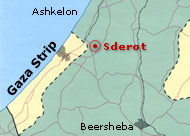
In Sderot, a steady stream of residents returned from week-ends spent outside
of the Qassam zone, outside of fear. The main street was again filled with
traffic and pedestrians. But only 161 out of the 900 children registered in
nursery schools and kindergarten came to class. They met in secure rooms and
bomb shelters, because the 15-20 second warning might not be sufficient to
get them to a secure location if the Color Red siren sounded.
This is the time of the year for matriculation exams for 11th and 12th graders.
Most have been bused to calmer environments in the cities north of us such
as Beersheba and Ashdod. But today, the math matriculation exams will be held
right in Sderot because 370 tough-minded students there said that they wanted
to take their exams right in their own town. Only 5 math students requested
to take the exams elsewhere. Sderot has a large population of immigrants,
mostly from the Caucasus area of Southern Russia and from Ethiopia. During
the recent upswing in violence, town officials have been hosting special activities
for those immigrants.
One of the rockets that hit Sderot on Monday, landed as Defense Minister Amir
Peretz turned out in his hometown to vote in the Labor Party primary election.
Some 60 seconds after he cast his vote, the Red alarm went off. His bodyguards
huddled around him while the rest of the people sought shelter. Being his
bodyguard is a dangerous job. At the polling station, Peretz sat with the
father of a wounded body guard who lost both legs last November when a Qassam
rocket landed near Peretz’s home.
Also from Tuesday’s Jerusalem Post:
“Hours after she was released from the hospital on Monday, Susannah
Oz, heavily sedated and six months pregnant, buried her husband, who was killed
when a Kassam rocket landed near his car Sunday in Sderot. Oshri Oz, 36, of
Hod Hasheron, visited Sderot regularly as a computer technician…’Friends
are staying with her for the moment,’ Susannah’s father told The
Jerusalem Post before the funeral. ‘I am terrified that she is going
to go to pieces.’
‘Everything has been smashed to smithereens,’ he said. ‘I
don’t know how we will be able to go on as a family. I loved him very
much and we were very close…he was like a son to me.’ …
municipal workers had provided the family with psychological counseling, including
guidance on how to break the news to Daniella, the couple’s two-year-old
daughter.”
Can you imagine being the Sheriff of Sderot? That is the job of Police Chief
Uri Bar-Lev, the subject of yet another human interest story in Tuesday’s
Jerusalem Post. The text describes his typical day. He notices a young woman
who has stopped her car and is paralyzed with fear, unable to turn off the
engine or leave the vehicle:
“As the first rocket falls in the distance, Bar-Lev leans into the woman’s
car, slowly coaxing her to leave the vehicle and take cover in a nearby house.
A second later, a rocket shrieks overhead, plunging into a nearby house, but
Bar-Lev does not show that he has even heard the boom. Slowly and shakily,
the woman, a Sderot resident who has witnessed one too many barrages in recent
days, exits the car and is escorted into a nearby house, whose residents have
opened their doors to the passers-by. After making sure that the woman is
safely ensconced, Bar-Lev gets back into his car and speeds away, arriving
first at the scene where the shrieking Kassam has barreled through the house’s
wall. Realizing that he is the first responder, he checks to make sure that
his first aid kit is ready, scopes out the scene, and crouches down next to
the house’s owner, who is holding his ears and rocking back and forth
in shock.
“The intimacy in Sderot can be seen on a daily basis, in the interactions
between police and residents. ‘We understand that, sometimes, they need
to release their stress,’ says the station chief. ‘When they want
to demonstrate, I respect their right and their desire to do so…I am
ultimately responsible for determining what is the red line of acceptability
that they cannot cross.’ Most of the time, he says, dialogue with the
residents is all that is needed to keep demonstrations from spinning out of
hand.”
The article goes on to describe a typical interaction as the Chief instructs
his police officers to roll up their tape barrier, a half hour after the final
rocket strike of the night. One of the locals shakes his fist in anger: “Do
you see this? The government doesn’t care about us! Nobody cares about
us.” And then the angry man continues in a calmer voice, “Except
you. You’re always here.” The police in Sderot become the voice
of Israel. They meet with immigrant residents who say that they have no other
country. “We are here. We are staying here. 1,000 rockets might fall,
but I will stay here because it is my home.”
“This is our real strength,” says Bar-Lev in the interview. “The
deciding factor is the fortitude of the people. Not just to stay because of
economic motives, but also on an ideological level. The most important answer
to terror is that statement, “Nobody is going to force me out of here.”
_________________________________________________________________
I’m reminded of the gatekeeper at the marina. As we approached the gates
to the marina docks upon returning from our tour of Israel, Dubi, our driver/guide,
asked the gateman whether he would open it for us and permit us to drive right
to our dock to unload the luggage in the trunk. At first, he refused and a
long conversation in Hebrew ensued, followed by cell phone calls to his superiors.
Eventually, permission was granted. The gateman conveyed his fears to Dubi
who translated for us:
“You see, I am really afraid for security. I do not want any bombs at
the marina. I live in the village of Sderot. We just had another rocket attack
yesterday. Killed a man. This is the second killing in our village within
a week, I am jumpy.”
What can I do? I feel so helpless, knowing that Pacific Bliss will just pull
out of Ashkelon and sail on its way. I feel compassion for these people who
live here. But there is more than just feeling their pain. I admire and respect
these people for living each day as if it were their last, yet planning eagerly
for the future. I’ve heard so many personal stories from people all
over Israel, but strangely, it’s the ones from Sderot that have burrowed
a hole into my heart.
________________________________________________________________
May 31st: The report on the brave students of Sderot planning to take the
math exam was broadcast on TV last night. This afternoon, more rockets struck
Sderot, right at the school where the students were taking the exam. Thank
God, none were hurt as they dashed into their shelters, lexams uncompleted.
Were those students a specific target of Hamas or Islamic Jihad? I believe
so. So don’t believe media claims that these Qassam rockets hitting
Israel are merely home-made armaments that don’t reach their intended
targets. They weren’t there. We were.